I was going through the list of things I need for making corned beef brisket and was surprised to discover one odd ingredient:

salt peter,

the form of potassium nitrate, KNO3, that occurs naturally, used in the manufacture of fireworks, fluxes, and gunpowder.

I checked the recipe twice and thought I read it right. Salt peter has been used for the longest time to cure meats.  It gives the meat its distinct red color. But, seriously, I wouldn’t add chemicals in my food just to make it look pretty. After all, the use of salt peter has already been discontinued ever since modern nitrates have been developed. This is actually a great example that demonstrates why I am a huge fan of making food from scratch at home: you know exactly what goes in your food.

Corning is a technique for preserving or curing meat by soaking it in brine for long periods of time.

“Curing, no matter which method, involves several processes, the most significant of which is denaturing of the proteins. This happens when salt is introduced to the meats proteins. Proteins are coils and the salt causes the proteins in the muscle fibers to unwind and absorb the extra water trapped inside. Water inside your meat spells trouble because bacteria love water so eliminating it by salting and drying allows for longer storage.” – Chef’s Corner

So what good stuff goes in to the corning solution?
 

Corned Beef


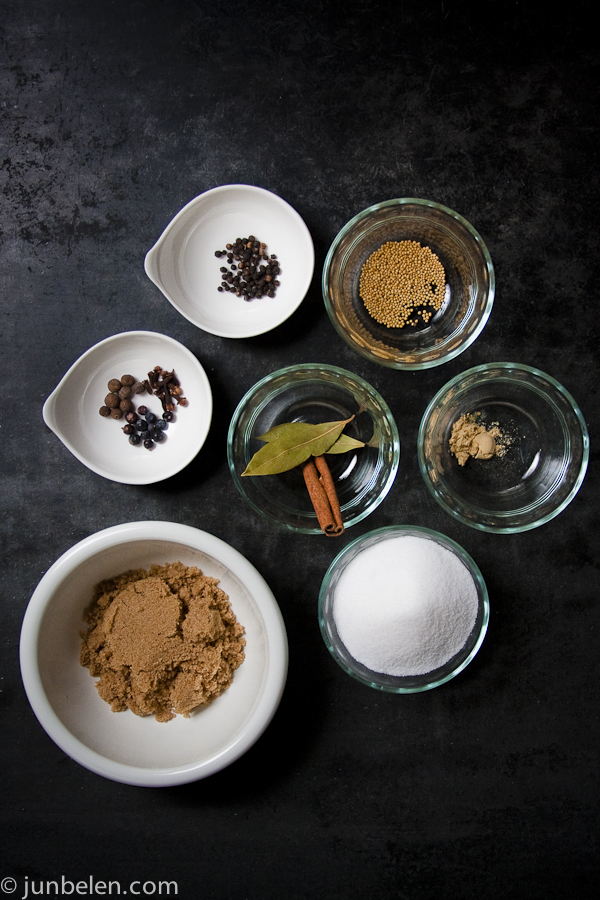
Corning the Beef Brisket, adapted from Alton Brown’s Good Eats

1 (4- to 5-lb) beef brisket, trimmed
2 quarts water
1 cup kosher salt
1/2 cup brown sugar
1 cinnamon stick, broken into several pieces
1 tsp mustard seeds
1 tsp black peppercorns
8 whole cloves
8 whole allspice berries
12 whole juniper berries
2 bay leaves, crumbled
1/2 tsp ground ginger
2 pounds ice (optional)

Place the water into a large stockpot along with salt, sugar, cinnamon stick, mustard seeds, peppercorns, cloves, allspice, juniper berries, bay leaves and ginger. Cook over high heat until the salt and sugar have dissolved. The aromatic fragrance of the spices is simply amazing.

Remove from the heat and add the ice.  Stir until the ice has melted.  Ice is added to cool down the solution but you can totally skip this and just refrigerate the brine until it reaches a temperature of 45 degrees F.

Once it has cooled, place the brisket in a 2-gallon zip top bag and add the brine.  Seal and lay flat inside a container, cover and place in the refrigerator for at least 10 days.   Check daily to make sure the beef is completely submerged and stir the brine. If you don’t have a huge zip top bag, brine the brisket in a large tupperware container and make sure to flip the brisket each day to make sure that all of the brisket comes in contact with the brine.


Cooking the Beef Brisket

1 small onion, quartered
1 large carrot, coarsely chopped
1 stalk celery, coarsely chopped

After at least 10 days, remove the brisket from the brine and rinse well under cool water.  Place the brisket into a pot just large enough to hold the meat, add the onion, carrot and celery and cover with water. Set over high heat and bring to a boil. Reduce the heat to low, cover and gently simmer for 2 1/2 to 3 hours or until the meat is fork tender.

Remove from the pot and thinly slice across the grain.

There are so many wonderful things you can do with corned beef. On the top of my list is a tasty Reuben sandwich: thin slices of corned beef with sauerkraut, Swiss cheese and Thousand Island dressing on lightly toasted rye bread.  And a personal favorite is crusty corned beef hash with eggs.

  • http://flickr.com/photos/mlpa Michael Buzz

    I was just watching that episode of Alton Brown last night and I wondered why he insisted that saltpeter needed to be added simply to make the meat red!

  • http://www.junbelen.com Jun Belen

    I’m simply not going to add something used for gunpowder in my food! I have been looking around at the ingredient list in store-bought corned beef and red beet powder seems to be used nowadays to make the meat red. I’d have to reprise this post in the future and see if it really works.

  • Pingback: How to Make a Reuben Sandwich at Home

  • Pingback: Best Corned Beef Sandwich in the City

  • Robert Stockburger

    ‘Caught the tail end of Alton Brown’s Food Network Show on how to make corned beef, am surprised and grateful to find the recipe reprized here. I remember the chow line jocky in boot camp serving bread slices and asking each of us if we wanted “Saltpeter or Regular” as we passed through the line…turns out the whole Boot Camp Experience required a sense of humor!

  • Pingback: How to Make Corned Beef Hash with Eggs at Home

  • corned beef mel

    you can always use “pink salt” or sodium nitrate-the amount in your cure is so teensy as to have vitually no effect at all on your health but sure as hell keeps the corned beef looking good-also curing salt imparts a particular salt flavor. ANd don’t worry, you probably aren’t eating corned beef everyday, and ingest plenty more harmful substances.

  • http://www.junbelen.com Jun Belen

    Have you heard about red beet powder? I’d have to try and see if this will make my brisket pink next time.

  • Pingback: Has anyone got a recipe for perfect crock pot/slow cooker brisket? | Slow Cooker Pot

  • Rachel

    if beets make the stool red, surely red-beet powder can make your beef red.

    btw, where do you find whole all-spice & juniper berries? i have all-spice powder, but i can’t even find juniper powder.

  • Chyrl

    I get some of my spices from spicesage.com. There are quite a few other internet sites that specialize in herbs and spices. Just google it. I’ve found it’s cheaper than a gourmet food store. One of the health food stores in my area carry those spices, too.

  • Ryan

    Was just about to make the Alton Brown corned beef when I came across this post–good to know I don’t have to use the salt peter.

    Without a reddening agent, though…what will the finished product look like? I really don’t want to add the nitrates/trites, but I also don’t want to chow down on really yummy gray meat!

  • http://www.junbelen.com Jun Belen

    Thanks Ryan for checking out the post. Our corned beef turned out brown – not gray – and it really wasn’t all that bad :-) We made Reuben sandwiches and you can check out our corned beef here: http://blog.junbelen.com/2010/03/16/how-to-make-a-reuben-sandwich-at-home/

    I’ve heard people using red beet powder: http://www.amazon.com/Red-Beet-Powder-2-oz/dp/B0001BGTSA to make their corned beef pink. Whole Foods’s corned beef lists red beet powder as an ingredient in their corned beef. I’ve yet to try this out for myself.

  • Pingback: My 100th Post: The Joy of Food Blogging

  • Chris

    Regardless of whether you want it in your food, Salt peter makes the best brine for cooking beef. I stopped buying it from butchers when they stopped using peter a few years back. You can get it online now although it is expensive.

  • Judy

    I use beet powder instead of nitrite. It turns the meat pinkish in color.

  • http://www.junbelen.com Jun Belen

    Thank you, Judy. I’d have to try beet powder soon. My corned beef looked fine when I didn’t add nitrites but I’m sure the pinkish color from the beet powder would make it even look better!

    Jun

  • dk

    sodium nitrate+vit c = nasty carcinogen, even when met within the body

  • Dan G

    You run a serious risk of botulism if you try to cure meat without nitrites or nitrates.

  • Pingback: To Kick This Blog Off… « Food For A Pilgrim

  • travis

    Delicious.
    I made corned venison w’ a year old frozen shoulder roast.

    So easy.. I will be doing this with the majority of my venison roasts from now on.

  • steve

    instead of a cinamin stick how much powdered cinamin should i use there ….. thankyou

  • http://www.junbelen.com Jun Belen

    Thank you, Steve for checking out the recipe. One cinnamon stick is roughly equivalent to 1/2 teaspoon of ground cinnamon. Let me know how it goes!
    Jun

  • Lance

    Hi Jun,

    Thank you for posting this recipe; I really look forward to trying it out. I have raised my own steers to achieve the healthy and quality meat my family deserves as we appreciate healthy alternatives to the store-bought foods.

    One question I have regarding your use of ice is that since 2lbs of ice is just under a quart of water; is the salt, sugar, and seasonings ratio specified in the ingredients list applicable to 2 quarts or 3 quarts of total water. My concern is underflavourly when 50% more water is added via the ice.

    Cheers, and all the best!

  • http://www.junbelen.com Jun Belen

    Hello Lance,
    Thank you for stopping by the blog. The recipe, as written, accounts for the extra quart of water so the amount and proportion of spices as written are correct.
    Thank you and best of luck with making the corned beef. let me know how it goes!
    Jun

  • ari

    Just out of curiosity, are you really doing 1 cup of (kosher) salt to 3 quarts of water (with the ice)? Because that seems like a spectacular amount. I make quite a bit of pastrami for our pub (up to 15 pounds a week) and at most I do 1.5 cups of regular salt to 8 quarts of water. I’ve been using Harold McGee’s book “On Food and Cooking” to get a sense of the effects of salt on the meat: 3% salt on the low end, 4.5% on the high end. You’re between 8% and 9%. Where’s the recipe from?

  • ari

    Just out of curiosity, are you really doing 1 cup of (kosher) salt to 3 quarts of water (with the ice)? Because that seems like a spectacular amount. I make quite a bit of pastrami for our pub (up to 15 pounds a week) and at most I do 1.5 cups of regular salt to 8 quarts of water. I’ve been using Harold McGee’s book “On Food and Cooking” to get a sense of the effects of salt on the meat: 3% salt on the low end, 4.5% on the high end. You’re between 8% and 9%. Where’s the recipe from?

  • ari

    I think I figured it out – Kosher salt vs. Table salt. AHA!

  • ari

    I think I figured it out – Kosher salt vs. Table salt. AHA!

  • Brijnet23

    Ever hear of plagiarism ?

    You copied your recipe and process word for word from another site. It is a disgrace to pass it off as your own work.

  • http://blog.junbelen.com/ Jun Belen

    Thank you for stopping by my blog. But clearly you missed the credit I gave to Alton Brown for his wonderful recipe.

  • http://blog.junbelen.com/ Jun Belen

    Thank you, Ari for stopping by my blog. And yes, you figured it out! It’s easy to get lost with kosher versus table versus sea salts. Hope you enjoyed your homemade corned beef!

  • Almonrf20

    nice have been making different version brines and liked this one but threw in sum of my own herbs. Thx for idea.

  • maggiejiggs

    No one uses sodium nitrate anymore. We use sodium nitrite; in curing, it is commonly called pink salt, which is 93.75% table salt and 6.25% sodium nitrite. Please read “On Food and Cooking” to get the facts straight, and to understand why we cure with this substance.

  • maggiejiggs

    Meant to say no one uses sodium nitrate in home-cured corned beef. And my brine consists of 1 gallon H2O, 2 cups kosher salt and 1/2 cup sugar. From Charcuterie, Michael Ruhlman & Brian Poleyn.

  • http://blog.junbelen.com/ Jun Belen

    Thank you for your very thoughtful comment. Using nitrates/nitrites in curing beef is a polarizing issue. Some people are passionately against it while some people, like yourself, are totally fine with it. I love the taste of my corned beef the way Alton Brown makes it minus the salt peter and other chemicals. I don’t mind that my corned beef is brown and not pink and we don’t keep it stored for a long time — it’s gone in less than a week! And so coloring and preserving the meat, which one gets from the use of nitrates/nitrites are not important to me.

    Thank you for sharing your brining solution. I’ve met Michael Ruhlman and I love his books. But I’ve found a recipe that works for what I need and what I want. To each his own.

  • maggiejiggs

    Everything we eat and are made of is a chemical : ) and you should get your chemical terms right..
    Please do a little research on bacteria such as Listeria. I’m not talking about eating the cured beef up quickly, I’m talking about what can happen to it while it’s “curing.” Listeria is a killer, and is tolerant of cool temperatures (like your refrigerator) and high salt content (like your brine).
    Again, I’m concerned about the curing process, the time the beef is left in the brine (we’re talking 10 days!). This is when you need to worry about contamination! You can’t see or smell what happens during that period, but it can kill you.

  • maggiejiggs

    I am not talking about storage, I am talking about what happens in the 10 days you are curing it!!! (Have you ever done any home canning?) What happens to the meat in those days is paramount to food safety. If a bacterium is introduced, and multiplies, bingo!!! Look at all the E-coli outbreaks we’ve had with fresh vegetables. Again, no salt peter. 6.25% NITRITE. Inhibits the growth of Clostridium botulinum. You know, the botulism bacterium! Also, look up Listeria (extremely nasty bugger)…it is tolerant of adverse conditions, such as low temperatures (like your refrigerator) and high salt concentration (like your brine). I don’t care about the color of the meat, I care about my family’s health. I once ate dinner out with friends. Three of us had the scallop entree. I ended up in the hospital with food poisoning. They didn’t. It’s sometimes the luck of the draw, but I prefer minimizing the odds.

  • http://blog.junbelen.com/ Jun Belen

    Thank you once again for the notes you’ve written. I totally understand your point about food safety. But I just want to thrown in the importance of using trusted food sources in the discussion. I try my best to source my meats, fish, and produce from trusted local and sustainable sources. Organic, whenever possible. Grass-fed beef. Sustainable seafood. I know where my food comes from and I know what I put in it. Those two things are very important to me.

  • Ann

    Didn’t find beet powder but did peel and finely grate a raw beet. Then added 2 cups of the alloted water and swirled it around until the beets released their beautiful color. I strained and added the liquid after the spiced brew had cooled, then added the brisket.

  • http://blog.junbelen.com/ Jun Belen

    Hi Ari, it’s Kosher and not table salt.

  • http://blog.junbelen.com/ Jun Belen

    Hi Ann, let me know if it made the beef pinker. We just cooked a batch of corned beef a couple of days ago where we added 1 tablespoon of red beet powder (it was a 5-pound beef brisket) and the beef was a bit pinker but not really pink. We figured the amount of red beet powder wasn’t enough. We’ll bump it up in our next batch.

  • Mumsies

    thank you for this recipe, and your kind response to those that promoted nitrites. i know my food source also. My dr recommended 20 yrs ago that i avoid all nitrites and bbq’d blackened foods. As these were known carcinogens. and since my dr is at fred hutch in seattle, i will trust his recommendations. again thx for the modifications on this recipe. buster

  • Pingback: Corned Beef and Cabbage — Wellness Mama

  • Heero

    I know this is a really late reply, but please realise that Botulism toxins are extremely heat labile. When you cook your corned beef, as long as the beef has been cooked at higher than 85 degrees Celsius for 10 minutes, all of the toxin will become inactivated if there was any to begin with.

    No one eats corned beef raw. The boil/simmer is enough to destroy the toxin.

    Home canning is different because most people just pop open the can and eat.

    Source: USDA and everywhere else on the internet. I’m also a microbiologist, professional cook in training, and future health inspector.

  • http://blog.junbelen.com/ Jun Belen

    Thank you for the very useful clarification, Heero!

  • Marijo_kernan

    Hi Jun:
    I have been searching for nitrate-free… this seems the best and convincing so far… your ingredients are interesting and I think will not give me a flat note taste corned beef… I will try to do this tomorrow and will get back to you after 11 days… keep on writing and experimenting on foods…
    Thanks,
    MariJo

  • Rachel

    Maggie, while you’re correct, you’re also incorrect in your worrying. I am a professional cook and cheese-maker with some science background; and am always in contact with the health department on toxins et al. Listeria and Botulism can kill you–although listeria generally just makes people ill (unless young or old, like many things)–but both of these things are incredibly heat sensitive. Thus the pasteurization of milk and canning at a high temperature for 30 minutes kills these particular items.

    I returned to give kudos to this recipe and found this thread–I had noticed someone stating concerns about botulism in a previous thread when I copied the recipe down and was sadly dismayed. Here is a great recipe that won’t kill you. I cooked my brisket for four hours at a very steady simmer. That will kill anything that may have developed while brining. Likewise, most people would dispose of their brine contents as they would handle any raw meat product–carefully. If concerned, a sterile bleach solution wipe down will help.

    It’s important to note this is brined meat that is cooked. Not ‘cured’ meat that will not be cooked, or only smoked–this is where one would be in the danger zone, so to speak. And i’m only going out of my way to state these facts as this is a great recipe, and no one needs to be concerned of dying. In addition omitting nitrites from this recipe may put many people AT EASE. The concern about additional nitrites in foods is because there have been many studies done that show the formation of carcinogenic nitrosamines in meats treated with sodium nitrite when exposed to high temperatures–like corned beef. I use preservatives and work in the wine industry (where we use SO2–sulfur dioxide) and care for my own flock of sheep in which i make cheese (and soap). I am not shy of using chemicals. However, the beauty of being able to brine your own meat, and then cook it, means one does not need to use nitrites if they wish not to–and feel completely safe. When I removed my beef, I disposed of the brine properly, rinsed it and smelled it thoroughly for any sign of decay (obviously toxins would not present themselves in the touch/smell/sight test). Beef looked great. Cooked it for a long time (as you would for any brisket) and ate it last night and it was PERFECT. No one has died. Yet. :)

  • Rachel

    so…sorry for the long comment concerning toxins (this recipe will not kill anyone)..but i wanted to say how great this was. We had it for st. paddy’s day last night and it was a huge hit. Wanted to share a few things i did differently: I used pickling spice mix as I had it (which included chili peppers), and added star anise & cinnamon–nice flavor.

    For cooking, I cooked the brisket in with cabbage and onion and covered the mixture in beer.

    I then roasted carrots and potatoes with olive oil and caraway seeds…and when it was all done I made a huge platter with brisket on one side, potatoes and carrots in the middle and the cooked cabbage and onions on the end–the juices from the cabbage soaked into the roasted potatoes and carrots..and it was just perfect.

    Great recipe–thanks for sharing Alton’s, and also for being an advocate for nitrite free option. It can be done (and i think it’s important for people to know that since the majority of people do not keep sodium nitrite in their kitchen).

    By the way another way to use the left over brisket–tacos! Corn tortilla, warmed brisket, little tapatio, and crunch cabbage and onion. Yum!

  • Timber Dan

    Can you tell me why I shouldn’t use natural occuring KNo3 because it is a “chemical” yet it is fine to use NaCl which is also a natural occuring “chemical”.